

A micro piston air pump for pneumatic automation works well when a machine needs a compact local air source and the pneumatic demand stays within the pump's verified range. Pump size should follow the complete machine cycle, including actuator timing, short peak demand, pressure recovery, and the number of actuators moving together.
A slow pneumatic actuator does not always need a larger pump. Tubing, valves, actuator timing, or an unsuitable air-supply layout can create the same symptom.
Quick Answer: How Should You Size the Air Supply?
For compact automation, check how the machine uses air during one complete production cycle.
● Identify which actuators move at the same time.
● Check whether airflow demand is continuous or lasts only a few seconds.
● Consider a reservoir when the machine has short strokes and longer pauses.
● Check tubing, valves, fittings, and exhaust restrictions before increasing pump size.
● Validate pressure recovery and cycle time in the finished machine.
When Does a Micro Piston Air Pump Fit Automation?
A micro piston air pump is most useful when the machine needs its own pneumatic source. Portable equipment, standalone test fixtures, remote modules, and compact packaging mechanisms are common examples.
Machines with an existing high-capacity plant air network may have little reason to add another air source. High-flow cylinders and equipment operating from several-bar factory air also need careful evaluation before switching to a micro pump.
| Machine Condition | Local Micro Piston Air Pump | Plant Compressed Air |
|---|---|---|
| Portable equipment | Suitable for local air supply | Air hose limits mobility |
| Standalone test fixture | Suitable for standalone use | May require new air piping |
| Small remote module | Suitable where no air line is available | Depends on site air supply |
| Low-air-demand mechanism | Worth evaluating | May provide excess capacity |
| Multiple large cylinders | Check pressure and airflow first | Often more practical |
| Continuous high airflow | Usually not suitable | Usually more suitable |
For compact machines, the available micro piston pump options for automation can be compared after the machine air demand has been defined.
Industry actuator calculations also use working pressure, stroke, cylinder size, and cycle rate when estimating air demand. A suitable authority reference can be added here: Festo air-consumption reference.
Answer block: A local micro piston air pump makes sense when a compact machine needs independent air supply and has limited pneumatic demand. High-flow factory pneumatic equipment usually needs a larger air source.
Direct Pump or Pump + Air Reservoir?
The air-supply layout can change the pump requirement.
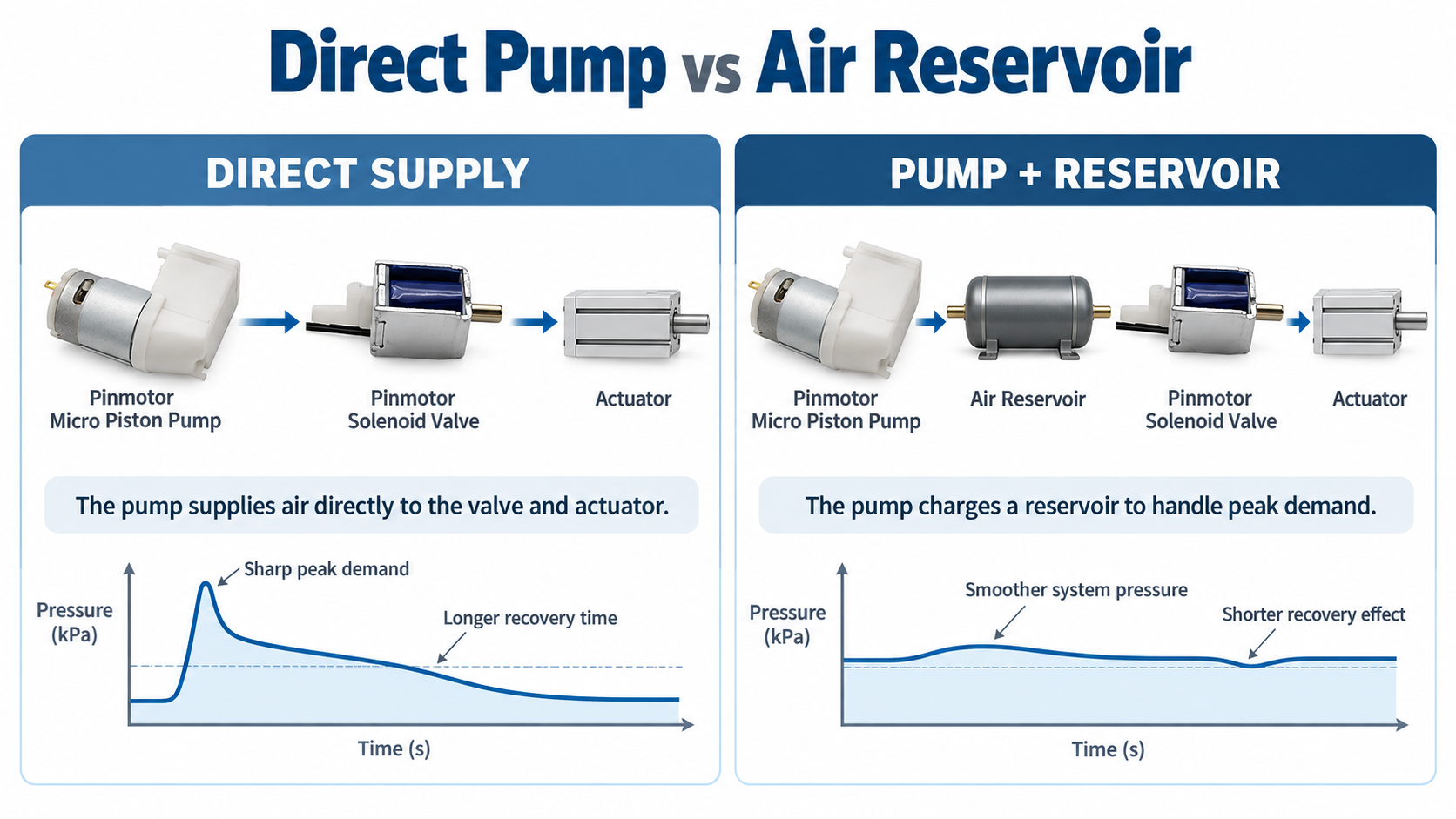
A direct system has a short pneumatic path:Pump → Solenoid Valve → Actuator
The pump supplies the actuator during movement. This layout works well for small mechanisms with relatively steady air demand and moderate movement speed.
A buffered system adds stored air:Pump → Air Reservoir → Solenoid Valve → Actuator
The pump fills the reservoir between machine cycles. The reservoir supplies part of the short airflow demand when the actuator moves.
| Machine Demand | Direct Pump | Pump + Reservoir |
|---|---|---|
| Low, steady air use | Suitable | Usually unnecessary |
| Short, fast actuator stroke | Check pump flow | Worth evaluating |
| Long pause between strokes | Suitable | Allows refill time |
| Several short peak events | May require larger pump | Can buffer peak demand |
| Continuous high airflow | Pump carries full load | Reservoir gives limited benefit |
| Very limited installation space | Fewer components | Requires extra space |
A reservoir can work well when an actuator operates for one second and then waits ten or twenty seconds. The pump has time to restore reservoir pressure before the next movement.
Continuous air consumption creates a different condition. The pump must still provide enough sustained airflow because stored air will eventually be depleted.
Answer block: Use direct supply for steady, low-air-demand mechanisms. Evaluate a reservoir when an actuator needs a short airflow burst followed by enough time for the pump to restore pressure.
How Does Actuator Sequencing Change Peak Air Demand?
The PLC sequence can affect pneumatic system size.
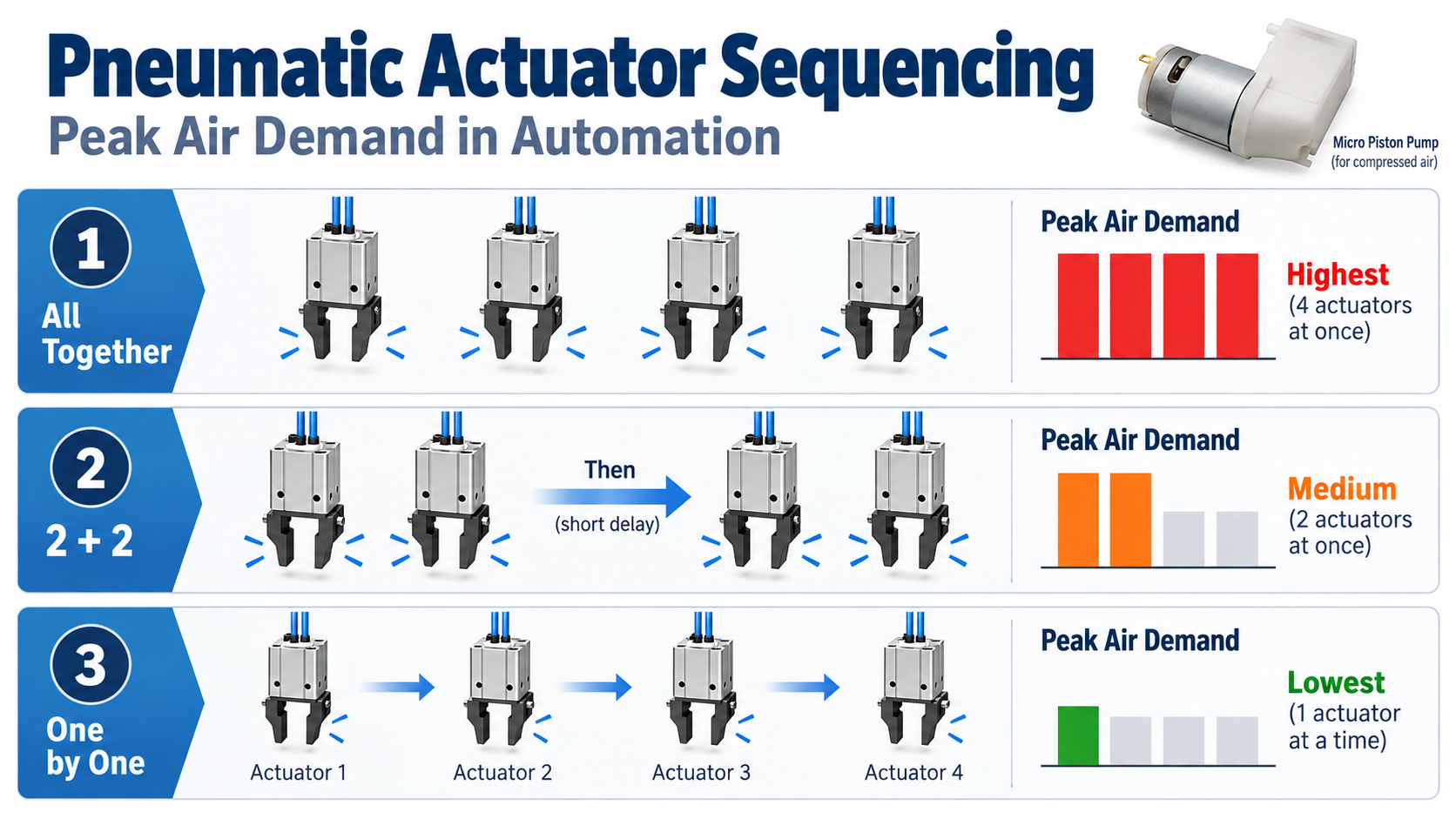
Consider an assembly fixture with four pneumatic grippers. If all four grippers close at the same moment, the local air source sees their combined short-term demand.
The same fixture may allow another sequence:
Gripper 1 + 2 → short delay → Gripper 3 + 4
The machine still completes the same mechanical operation, but the highest simultaneous airflow demand can fall.
| Actuator Sequence | Peak Air Demand |
|---|---|
| Four actuators together | Highest |
| Two groups of two | Lower |
| One actuator at a time | Lowest |
| Staggered movements | Depends on timing overlap |
A 200–500 ms delay may be acceptable in some machines. Other production processes require every actuator to move at exactly the same time. The control engineer should confirm the production-cycle limit before changing actuator timing.
Pneumatic sizing references commonly separate total air consumption from the airflow needed to achieve actuator speed. A supporting authority link can be placed here: SMC pneumatic sizing reference.
Answer block: Count the actuators that can demand air at the same moment. PLC sequencing can reduce peak air demand when the production process allows staggered actuator movement.
How to Check the Pneumatic System Before Upsizing the Pump
A larger micro piston air pump will only help when pump capacity is the actual restriction.
Air passes through tubing, fittings, filters, valves, and actuator ports before it produces mechanical movement. Any narrow passage can limit airflow.
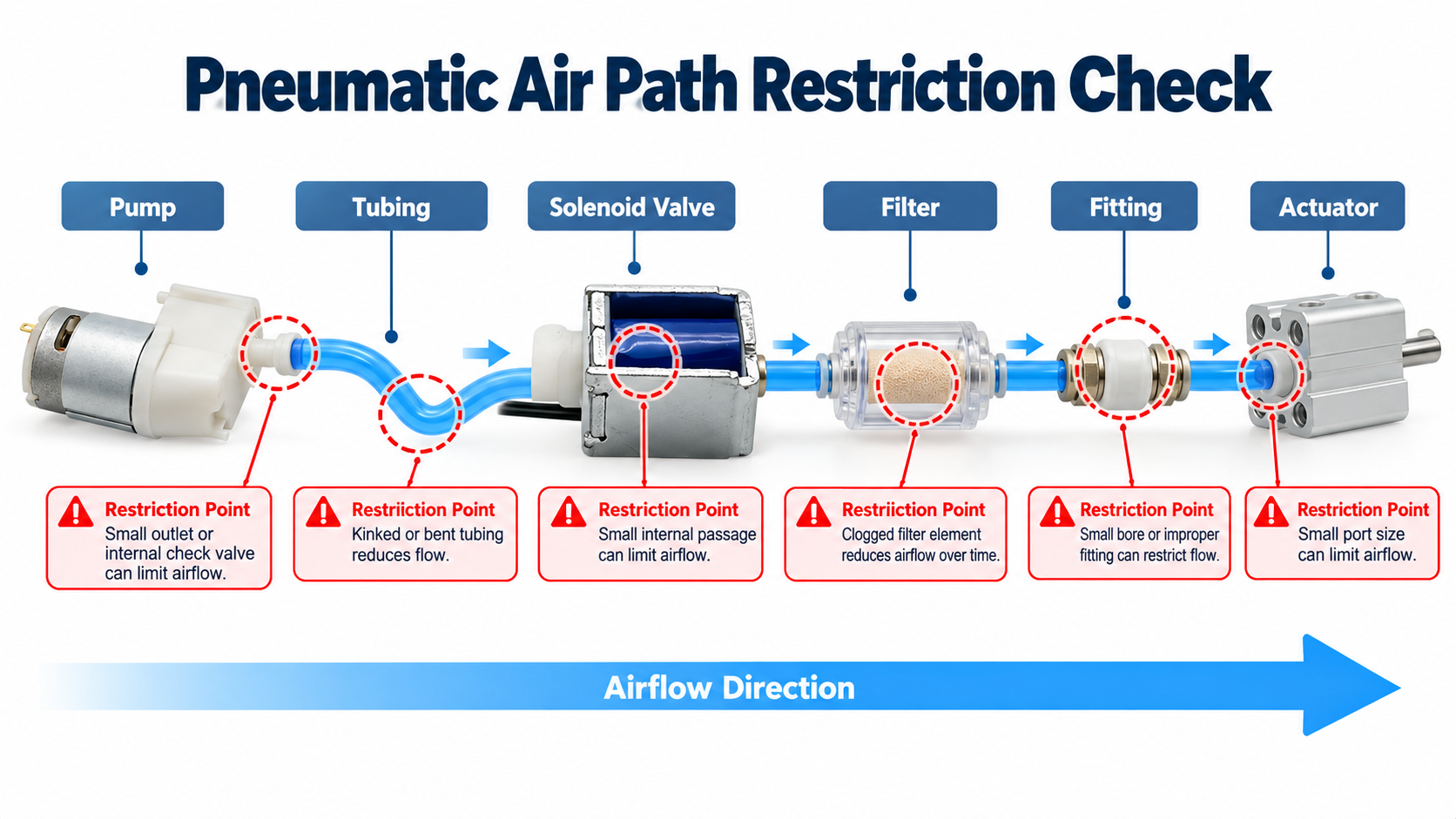
Use this five-step check before selecting a larger pump:
1、Measure actuator movement time. Record the actual opening, closing, extension, or retraction time.
2、Check pressure near the actuator. Measure pressure during movement, not only when the system is idle.
3、Inspect the solenoid valve. Confirm that valve flow capacity matches the actuator demand.
4、Check tubing and fittings. Long tubing, small internal diameters, and narrow fittings increase restriction.
5、Repeat the machine cycle. Watch whether performance changes after repeated movements.
| Component | Possible Restriction |
|---|---|
| Tubing | Too narrow or too long |
| Solenoid valve | Flow capacity too low |
| Fitting | Small internal passage |
| Filter | Excess pressure drop |
| Muffler | Restricted exhaust |
| Actuator port | Small inlet or outlet |
| Control timing | Valve command too early or late |
If pressure and airflow at the pump operating point still need confirmation, use the pressure and flow working point guide for that calculation. The detailed P-Q explanation belongs on that technical page, so this automation article only uses the result.
Answer block: If a larger pump produces little improvement in actuator speed, inspect the pneumatic path. Tubing, valves, fittings, filters, exhaust components, and actuator ports can restrict airflow downstream of the pump.
How Can You Tell If a Micro Piston Air Pump Is Oversized?
Low pump utilization alone does not prove oversizing. Some machines need reserve capacity for a short peak event.
Look at how the complete machine behaves across repeated production cycles.
| Machine Behavior | What It May Mean |
|---|---|
| Pump reaches control pressure almost immediately | Pump capacity may exceed cycle demand |
| Reservoir remains almost full | Stored-air capacity may be excessive |
| Larger pump does not improve stroke time | Restriction may be elsewhere |
| Startup current increases without cycle benefit | Pump may be larger than needed |
| Pressure cannot recover before next cycle | Air supply may be too small |
| Repeated cycles become slower | Recovery capacity may be insufficient |
| Pump starts often during hold condition | Check system leakage |
1、Oversized System
The air source has substantially more capacity than the normal machine cycle uses, while the extra capacity gives little improvement in production time or actuator performance.
2、Suitable System Size
The machine completes repeated cycles at the required speed and restores pressure before the next demand event.
3、Undersized System
Pressure recovery takes too long, actuator movement slows during repeated cycles, or the machine cannot maintain the required production sequence.
A pressure-test fixture needs another check. Frequent pump starting during a hold period may come from system leakage. A larger pump can hide the symptom without correcting the leak.
Answer block: Judge oversizing from machine behavior. Extra pump capacity that provides no measurable cycle-time or pressure-recovery benefit may indicate an oversized air source.
Which Automation Applications Fit a Local Micro Piston Air Pump?
The application name alone does not determine pump size. The machine sequence gives more useful information.
| Automation Application | Main System Question |
|---|---|
| Pneumatic gripper | Can the gripper close within the target time? |
| Packaging module | Can pressure recover before the next package cycle? |
| Assembly fixture | How many actuators move together? |
| Pressure-test station | How quickly can pressure recover after venting or leakage? |
| Portable automation | Can the machine operate without an external air line? |
| Robotic end tool | Can local air supply reduce external hoses? |
A packaging mechanism may use little air over one minute but still need a short burst during sealing or clamping.
A pressure-test fixture may have a different requirement. Once the target pressure has been reached, the system may need very little additional airflow unless leakage occurs.
These two applications can therefore use different pneumatic layouts even when the maximum pressure requirement looks similar.
Answer block: Match the pneumatic architecture to the machine task. Grippers depend heavily on movement time, packaging systems depend on pressure recovery, and pressure-test fixtures need stable hold behavior and leakage control.
How Should You Validate the Complete Machine Cycle?
Bench pump data confirms the pump itself. Machine testing confirms whether the entire pneumatic control system works.
Use the planned production tubing, solenoid valves, fittings, filters, reservoir, actuator configuration, and PLC sequence during the test.
Automation Acceptance Test
| Machine Test | What to Record |
|---|---|
| First actuator movement | Stroke time |
| 20 repeated cycles | Cycle consistency |
| Maximum simultaneous demand | Pressure drop |
| Sequential actuation | Pressure recovery |
| Reservoir refill | Recovery time |
| Hold condition | Pressure decay |
| Long production sequence | Cycle stability |
| Restart after stop | Recovery behavior |
For a packaging machine, check whether pressure returns before the next package enters the station.
For an assembly fixture, compare simultaneous and staggered actuator sequences.
For a pressure-test machine, measure pressure decay during the hold period and recovery after venting.
Production-style testing also shows whether a reservoir is too small, too large, or unnecessary.
If the final project needs changes to ports, wires, connectors, mounting, voltage, or pump performance, the next step is custom micro piston pump integration.
Answer block: Validate the complete machine cycle with production-style pneumatic parts. Stroke time, repeated-cycle consistency, peak pressure drop, reservoir recovery, and hold-pressure decay show whether the local air source is correctly sized.
FAQ
1、Q: Can a micro piston air pump replace factory compressed air?
A micro piston air pump can supply compact modules with limited pressure and airflow demand. Portable equipment, standalone fixtures, and small local pneumatic mechanisms are common cases to evaluate. Large cylinders, continuous high airflow, and factory equipment running from several-bar compressed air usually require a larger supply platform.
2、Q: When should I add an air reservoir?
An air reservoir can help when an actuator needs a short airflow burst followed by enough time for the pump to restore pressure. Check reservoir volume, refill time, available installation space, and pressure range. Continuous high airflow will still depend on the sustained output of the pump.
3、Q: Can PLC timing reduce pneumatic peak demand?
Yes. Staggered actuator commands can reduce the number of actuators drawing air at the same moment. A short delay between actuator groups may lower peak demand without reducing production output. The acceptable delay depends on the machine process, safety sequence, and required cycle time.
4、Q: Why is an actuator still slow after fitting a larger pump?
Check tubing diameter, solenoid valve capacity, fittings, filters, exhaust mufflers, and actuator ports. Measure pressure near the actuator while the actuator moves. A large pressure drop downstream of the pump usually indicates a restriction in the pneumatic path.
5、Q: How do I know if the pneumatic system is oversized?
Look for excess capacity that provides little machine benefit. Typical signs include very short pump run times, a reservoir that stays nearly full, higher startup current, or no reduction in cycle time after installing a larger pump. Check these behaviors across repeated production cycles.
6、Q: Should every actuator be added together when sizing the air source?
Add simultaneous demand only for actuators that can operate at the same time. Sequential actuators create a different peak load. Review the PLC timing chart and identify overlapping pneumatic events before deciding how much short-term airflow the machine needs.
Request a Pneumatic Automation Pump Review
For a new micro piston air pump for pneumatic automation project, send Pinmotor the actuator models, required pressure, machine sequence, simultaneous actuator count, reservoir layout, target cycle time, and available pump space.
Pinmotor can review the pneumatic layout and recommend a pump configuration for prototype testing.
Post time: Oct-13-2026