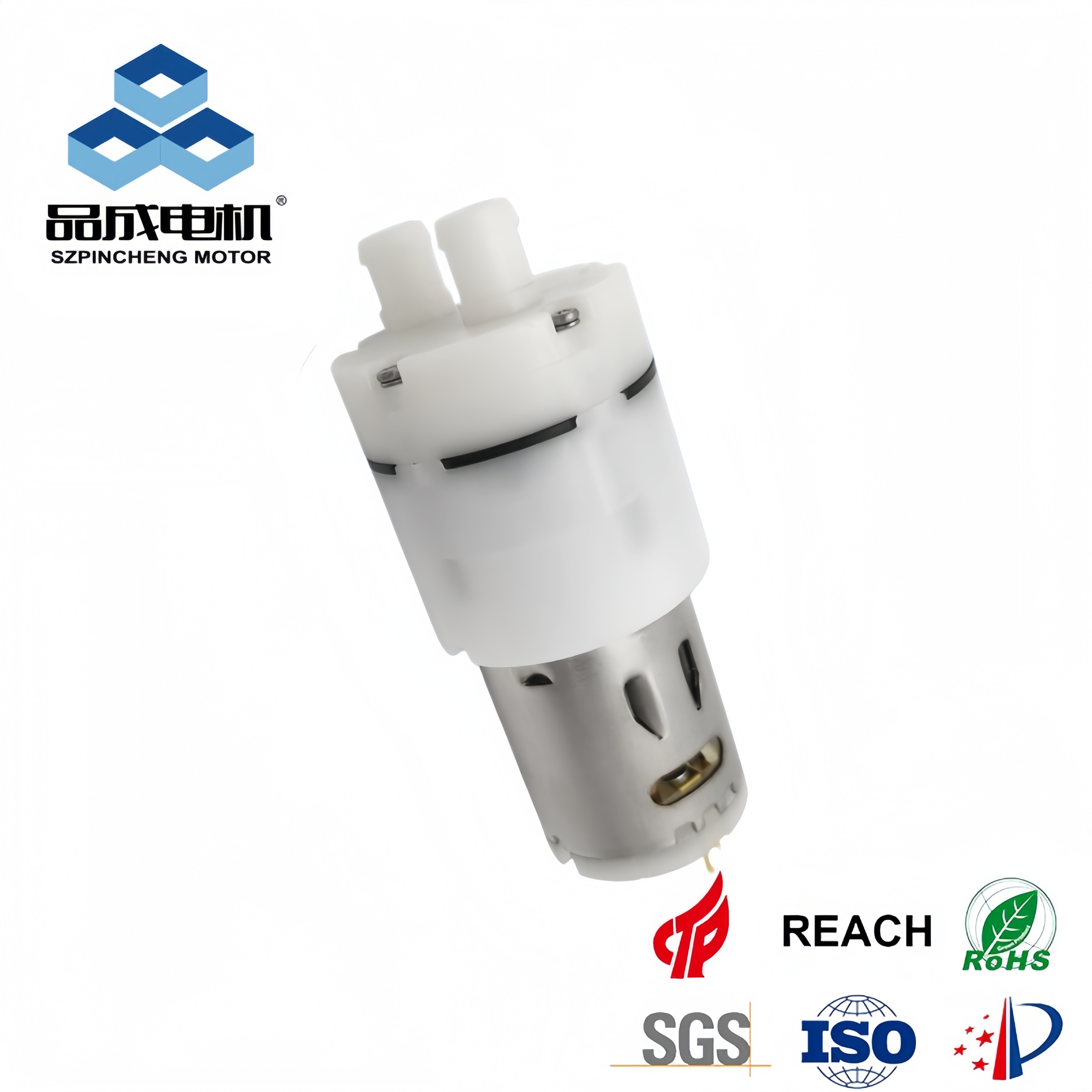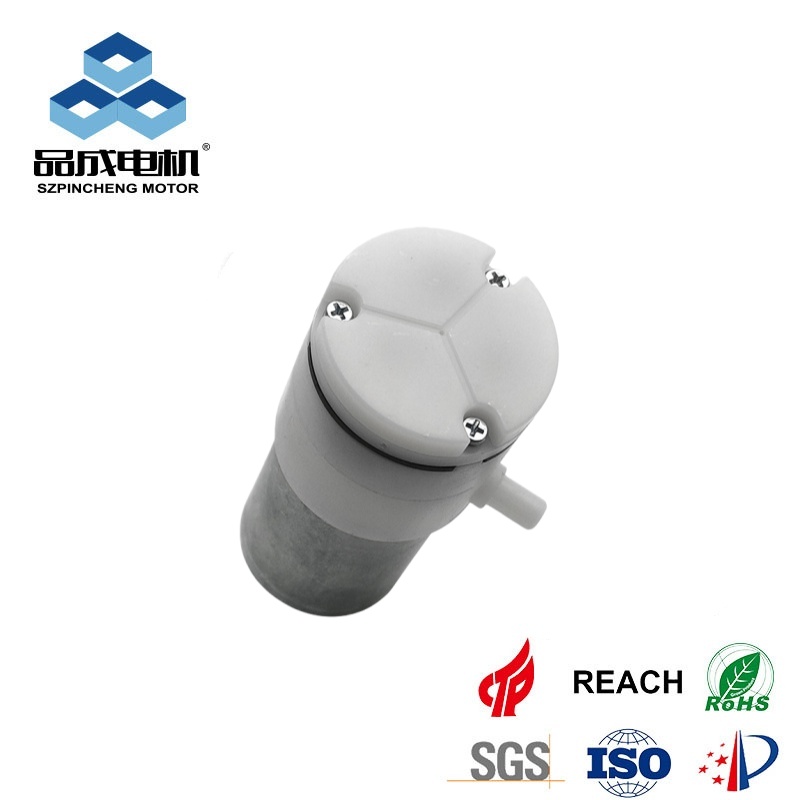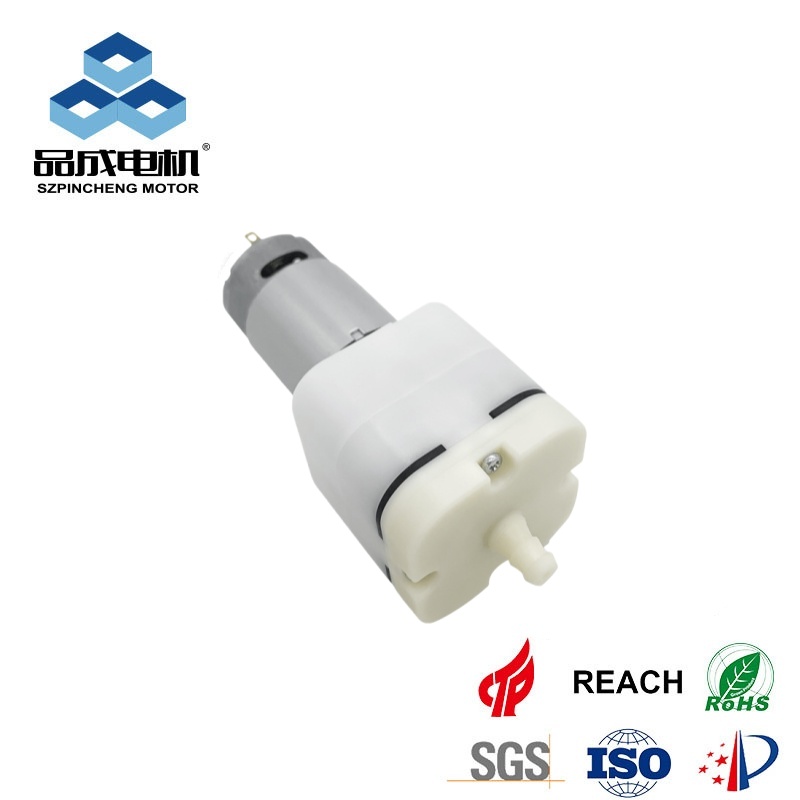

Low Noise Micro Air Pumps for OEM Equipment
Pinmotor low noise micro air pumps are designed to reduce motor sound, airflow pulsation and vibration transfer inside finished equipment.
Their compact diaphragm structure supports stable air delivery while helping manufacturers improve acoustic performance in medical devices, massage systems, beauty equipment, laboratory instruments and smart indoor products.
OEM options are available for voltage, connectors, air ports, mounting and other integration requirements.
Low Noise Micro Air Pump Range and Selection Guide
Pinmotor supplies low noise micro air pumps for portable devices, compact inflation modules, fixed 12V or 24V equipment and larger pneumatic chambers.
Selected low-noise configurations can operate at as low as 40 dB under defined test conditions. The suitable pump depends on the chamber volume, working pressure, target inflation time, power supply and operating cycle.
| Pump Range | Voltage Options | No-Load Airflow | Maximum Pressure | Recommended Use |
|---|---|---|---|---|
| Compact low-power | 3V–9V DC | 0.3–1.0 L/min | ≥50 kPa | Handheld products and small air chambers |
| Compact standard-flow | 3V–12V DC | 0.5–3.0 L/min | ≥60 kPa | Cuffs, small bladders and inflation modules |
| Wide-voltage | 3.7V–24V DC | 1.5–5.0 L/min | ≥60 kPa | Fixed equipment using 12V or 24V power |
| Higher-pressure | 3V–24V DC | 1.5–4.0 L/min | ≥80 kPa | Systems requiring additional pressure margin |
| High-flow | 6V–24V DC | 6.0–15.0 L/min | ≥75 kPa | Large air cells and shorter inflation cycles |
No-load airflow is measured with an open outlet. Actual airflow decreases as pressure rises, so the pump should be checked at the normal operating pressure.
How to Select the Right Low Noise Micro Air Pump
A small pump is suitable when the chamber volume and filling-time requirement are limited. A higher-flow pump is more appropriate for larger airbags or multi-cell systems, but it will not improve performance if the pneumatic circuit is too restrictive.
For fixed equipment, 12V and 24V low noise micro air pumps provide more voltage and airflow options. Battery-powered products should give greater attention to startup current, power consumption and available mounting space.
| Selection Factor | What the Customer Should Confirm | Engineering Consideration |
|---|---|---|
| Chamber volume | Volume of the cuff, bladder or air cell | Larger chambers require more airflow to meet the same filling time |
| Working pressure | Normal operating pressure, not only maximum pressure | The pump should have enough pressure margin to avoid continuous operation near its limit |
| Inflation time | Time allowed to reach the target pressure | Tubing, valves and manifolds must pass enough air for a higher-flow pump to be effective |
| Power supply | Rated voltage and controller current capacity | Startup current must be supported by the power supply and control board |
| Duty cycle | Operating time, rest time and daily cycle count | Longer operating periods increase motor temperature and may require better ventilation |
| Noise requirement | Target dB value, test distance and installation condition | Pumps requiring noise close to 40 dB should be tested inside the finished enclosure |
| Installation space | Pump dimensions, air-port direction and mounting position | Clearance and vibration-isolating mounts can reduce structure-borne noise |
A small pump is suitable when the chamber volume and filling-time requirement are limited. A higher-flow pump is more appropriate for larger airbags or multi-cell systems, but it will not improve performance if the pneumatic circuit is too restrictive.
For fixed equipment, 12V and 24V low noise micro air pumps provide more voltage and airflow options. Battery-powered products should give greater attention to startup current, power consumption and available mounting space.
Request a Pump Recommendation
Send your rated voltage, working pressure, chamber volume, target inflation time, operating cycle and installation drawing.
Silent Micro Air Pump Acoustic Technology
A micro diaphragm air pump generates sound through motor rotation, eccentric movement, diaphragm cycling, valve action and airflow through the pump head.
After installation, vibration can also pass into the bracket, tubing and equipment housing. Effective noise reduction therefore requires both pump-level adjustment and correct system integration.
Core Noise Reduction Technologies
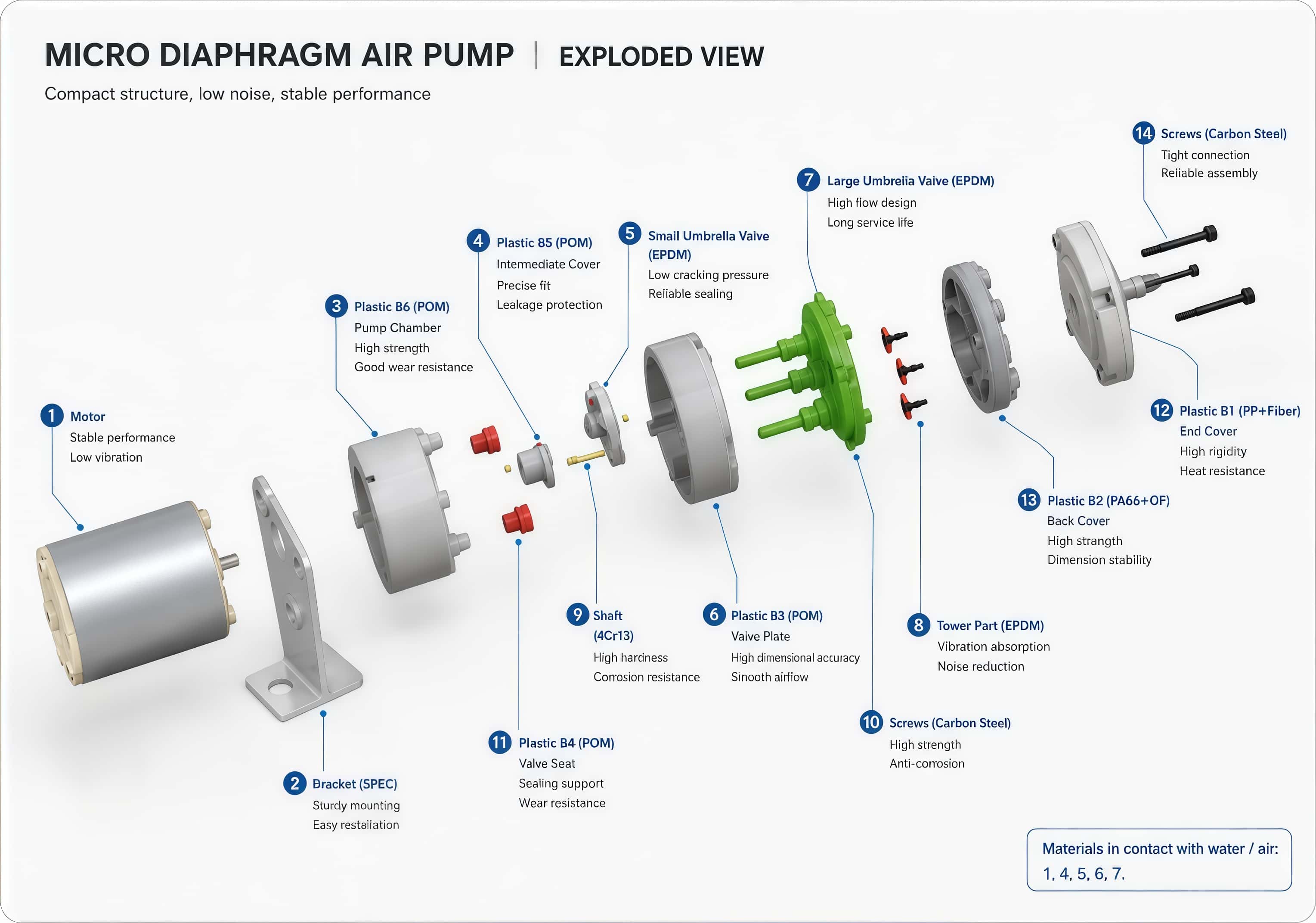
Motor Speed Matching
Motor speed affects airflow, current, temperature and vibration.
The motor should provide the required airflow at the working pressure without running faster than necessary. Excessive speed may shorten inflation time, but it can also increase operating noise and heat.
Diaphragm and Valve Optimization
The diaphragm and one-way valves affect pressure response, airflow pulsation, sealing and restart performance.
Valve stiffness and movement must be balanced to reduce impact noise while maintaining stable pressure and low leakage.
Vibration Isolation
Rigid mounting can transfer pump vibration directly into plastic panels or metal brackets.
Rubber or silicone mounts, flexible tubing and suitable clearance can reduce structure-borne noise without affecting installation stability.
Motor Speed Matching
Narrow tubing, small fittings and restrictive valves increase flow resistance. This may extend inflation time and place a higher load on the pump.
Pump ports, tubing, valves, manifolds and chamber volume should be checked as one pneumatic system.
Enclosure Integration
A pump may meet its noise target during standalone testing but become louder inside the finished product.
Common causes include rigid brackets, direct contact with the housing, unsupported panels and tight tubing connections. Final noise testing should therefore be completed with the production enclosure and pneumatic components installed.
Need to Reduce Pump Noise in Your Equipment?
Send us your working pressure, chamber volume, duty cycle, noise target and installation drawing. Pinmotor will review the pump, pneumatic circuit and mounting structure before recommending a suitable low noise micro air pump.
Low noise micro air pump Typical Applications
Low noise micro air pumps are suitable for equipment that operates close to the user or inside an enclosed housing. Pump selection should be based on chamber volume, working pressure, inflation time, duty cycle and installation conditions.
Blood Pressure Cuffs and Pneumatic Medical Equipment
Used for blood pressure cuffs, compression chambers and pneumatic rehabilitation components.
Key selection factors include:
● cuff or chamber volume
● target inflation time
● pressure overshoot
● leakage after shutdown
● restart under residual pressure
● control-board current capacity
The pump is supplied as a component. Validation and regulatory approval of the finished device remain the responsibility of the equipment manufacturer.
Pneumatic Massage and Compression Products
Suitable for massage cushions, leg compression systems and inflatable support products with one chamber or several valve-controlled air cells.
Confirm:
● the largest chamber filled at one time
● inflation sequence
● valve and manifold passage
● required ON/OFF cycle
● pump position inside the product
Higher airflow is useful for larger chambers, but restricted tubing or valves can still limit inflation speed.


Beauty and Personal-Care Devices
Used in compact beauty equipment requiring controlled air pressure or inflation.
Because the pump may be close to the face or hand, the finished product should be checked for:
● housing vibration
● sound at the user position
● pressure response
● temperature rise
● repeated short-cycle operation
Flexible tubing and vibration-isolating mounts can reduce noise transferred into the enclosure.
Smart Home and Indoor Equipment
Suitable for compact indoor pneumatic products and air-assisted household devices.
Check:
● power-supply compatibility
● installation clearance
● enclosure ventilation
● air-path resistance
● operating time
● sound level in the finished housing
Final testing should be completed with the production bracket, tubing, valves and enclosure installed.


Need Help Matching the Pump to Your Application?
Send your chamber volume, working pressure, inflation time, power supply, duty cycle and installation drawing.
Customization and Engineering Support
Standard pump platforms are tested first. Custom changes are made only when the existing configuration cannot meet the required pressure, airflow, noise level or installation layout.
Custom Low Noise Micro Air Pump Options
A custom low noise micro air pump can be adjusted to match the equipment power supply, air chamber and available installation space. Options include voltage, motor speed, airflow, pressure, wire length, connector, air-port direction and mounting position. For applications with tighter noise limits, the diaphragm, valves and vibration-isolating parts can also be reviewed. Each change is tested for current, temperature, working pressure, inflation time and operating noise.
OEM Silent Micro Air Pump Development
An OEM silent micro air pump project starts with the equipment drawing, working pressure, chamber volume, duty cycle and target noise level. The closest standard pump is selected and tested inside the finished product. If the result does not meet the requirement, the pump, tubing or mounting structure is adjusted. The approved sample, drawing and test conditions are then used as the reference for pilot production and batch supply.
Low Noise Air Pump Quality Control
Pinmotor inspects each low noise micro air pump against the approved project specification. Inspection items may include airflow, pressure, current, leakage, wiring polarity, function and noise. The noise limit should state the supply voltage, working pressure, measurement distance and mounting condition. Pinmotor operates under ISO 9001 and IATF 16949 quality-management systems. CE, RoHS and REACH documents may be provided for selected products.
Can you provide a pressure-flow curve?
Yes. A pressure-flow curve can be supplied for model evaluation, especially when the equipment has a fixed working pressure.
Is sample testing available before mass production?
Yes. Samples can be tested in the customer’s equipment before the pump specification is approved.
Can the pump restart with pressure remaining in the system?
Restart performance depends on the pump configuration and residual pressure. This condition should be included in sample testing.
What affects the service life of the pump?
Working pressure, duty cycle, supply voltage, ambient temperature and air cleanliness all affect pump life.
Is an air filter required?
A filter is recommended when dust, particles or moisture may enter the air path. Contamination can affect valve sealing and airflow.
Can the pump handle vapour, oil mist or special gases?
Material compatibility must be checked before use. Gas composition, temperature and humidity should be provided for evaluation.
How is batch consistency controlled?
Production is checked against the approved sample, drawing and inspection limits for airflow, pressure, current, leakage and function.
What compliance documents are available?
CE, RoHS and REACH documents may be available depending on the selected pump and project scope.
Need a Low Noise Pump for Your Project?
Send your equipment drawing and operating requirements. Pinmotor will recommend a suitable pump and arrange sample testing before mass production.