

Abstract: Why Small Water Pumps are Ubiquitous
This article provides a comprehensive look at the fundamental concepts and core operational mechanisms of micro water pumps. We will anylics dissect the structure and working principles of the three most common types: the Diaphragm Pump, the Centrifugal Pump, and the Peristaltic Pump, while presenting professional product selection and technical support from PinCheng Motor.
I. Basic Knowledge of Small Water Pumps
1.1 What is a Small Water Pump?
A Small Water Pump refers to a fluid transport device that is small in volume, compact in structure, and usually driven by a DC motor. Its working princeple is to convert mechanical energy into fluid energy to achieve the goals of liquid lifting, transport, or pressurization. Based on the ability to pump water without pre-filling the pump chamber, they are classified into standard pumps and miniature self-priming pumps.
1.2 Key Difference: Self-Priming vs. Non-Self-Priming
Standard Pumps (Non-Self-Priming)
-
Operating Characteristic: The pump chamber must be completely filled with the liquid to be transported before startup. Their maximum suction lift refers to the height the liquid can be raised after the initial priming (adding water) is complete.
-
Application Scenarios: Typically used when the liquid level is higher than the pump's installation position or when pre-start manual priming is acceptable.
Micro Self-Priming Pumps
-
Operating Characteristic: These pumps can generate high vacuum within the chamber using their internal design (such as a diaphragm or special structure) to draw liquid from a source below the pump's installation level, without the need for pre-priming.
-
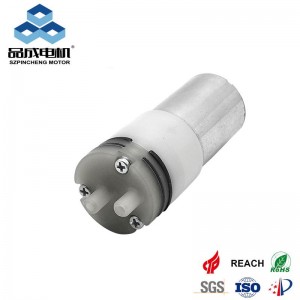
PinCheng Advantage: Taking the PinCheng Series Micro Self-Priming Pump as an example, its maximum self-priming height reaches 5 meters. This fulfills the true "no-priming, immediate draw" capability, making it ideal for applications with strict requirements for starting efficiency and installation placement.
Learn More: Explore the detailed specifications and application guide for PinCheng’s Self-Priming Pump
II. Working Principles and Structure of the Three Mainstream Miniature Pump Types
While diverse, small water pumps fundamentally rely on three core operating mechanisms: the small diaphragm pump, the small centrifugal pump, and the small peristaltic pump.
2.1 Structure and Application: Micro Diaphragm Pump
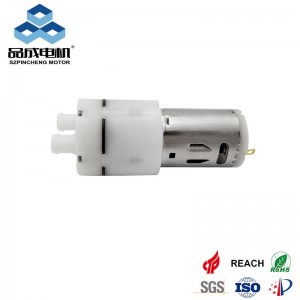
The diaphragm pump is one of the most common types of micro pumps, excelling in applications requiring precise metering, strong self-priming capability, and corrosion resistance.
Core Structure of the Diaphragm Pump
-
Drive Section: DC motor and a mechanical transmission mechanism (eccentric wheel or cam).
-
Pumping Section: The flexible Diaphragm, single-way check valves for inlet and outlet (usually made of rubber or FKM material), and the pump chamber.
How the Diaphragm Pump Works
-
Suction Stroke: The motor drives the eccentric wheel, causing the connecting rod to pull the diaphragm backward (away from the pump chamber). The pump chamber volume increases, creating a negative pressure (vacuum).
-
Valve Opening: Due to the vacuum, the inlet check valve opens, and external liquid is drawn into the pump chamber. Meanwhile, the outlet check valve remains closed.
-
Discharge Stroke: The eccentric wheel continues to rotate, pushing the diaphragm forward (toward the pump chamber). The chamber volume rapidly decreases, and the internal liquid pressure rises.
-
Liquid Ejection: When the chamber pressure exceeds the discharge line pressure, the inlet valve closes, the outlet valve opens, and the liquid is forcefully ejected.
-
Cycle: The reciprocating motion of the diaphragm creates a continuous process of suction and discharge.
Suitable Applications: High-precision self-priming, dual-purpose gas and liquid pumping, spraying, chemical dosing in water treatment.
2.2 Performance and Efficiency: Micro Centrifugal Pump
Centrifugal pumps are the go-to solution for high-flow applications, using a rotating impeller to dynamically transfer kinetic energy to the fluid.
Core Structure of the Centrifugal Pump
-
Impeller: A rotating component with vanes that is crucial for energy conversion.
-
Casing (Volute): The pump housing that surrounds the impeller, responsible for collecting the flung-out liquid and directing it towards the outlet.
-
Drive Motor: Provides the rotational power.
How the Centrifugal Pump Works
-
High-Speed Rotation: The motor drives the impeller to rotate at high velocity.
-
Centrifugal Force: The vanes force the liquid at the impeller center to rotate with it. The liquid is subjected to centrifugal force, throwing it radially outward from the center to the periphery of the impeller.
-
Kinetic Energy to Pressure: The liquid moves radially within the volute, gaining significant velocity (kinetic energy). As the liquid enters the widening section of the volute, its velocity slows down, and most of the kinetic energy is converted into static pressure energy (the pressure rises).
-
Low-Pressure Area: As liquid is flung out from the center, a local vacuum (low-pressure area) forms at the eye of the impeller. External liquid is continuously drawn into the impeller center by atmospheric pressure.
-
Continuous Transport: Liquid exits the discharge port, enabling continuous fluid transport.
Suitable Applications: Water circulation cooling, high-volume fluid transfer, aquariums, hot water recirculation.
Product Recommendation: PinCheng 370 Series Micro Centrifugal Water Pumps offer stable and reliable solutions for industrial cooling and water circulation.
2.3 Precision and Isolation: Miniature Peristaltic Pump
The peristaltic pump (also known as a tube pump) is distinct due to its zero-contamination fluid handling and extremely high-precision metering capabilities, making it indispensable in medical and laboratory settings.
Core Structure of the Peristaltic Pump
-
Pump Head: Contains the rotor and rollers.
-
Tubing: A flexible tube made of specific materials, through which the fluid flows exclusively.
-
Drive Motor: Rotates the rotor.
How the Peristaltic Pump Works
-
Compression and Occlusion: The tubing is fitted between the inner wall of the pump head and the rotor. As the motor drives the rotor, the rollers sequentially compress and roll along the tubing.
-
Creating a "Pillow": The compression process momentarily closes the squeezed section of the tube, creating a fluid "pillow" that isolates the liquid within from both the inlet and outlet.
-
Pumping and Suction: As the roller moves forward, this "pillow" of fluid is displaced toward the outlet. Simultaneously, as the roller moves away, the compressed tube restores its shape using its inherent elasticity, creating a vacuum at the inlet end and drawing in new liquid.
-
Precise Metering: Since the volume of each "pillow" is constant, controlling the rotational speed allows for extremely high-precision flow rate management.
Suitable Applications: Medical devices (infusion, dialysis), laboratory reagent transfer, precise additive dispensing in food and beverage.
III. User Selection Guide and PinCheng Solutions
Selecting the appropriate miniature water pump requires a holistic consideration of flow rate, head (pressure), self-priming capability, operating voltage, and fluid properties.
| Pump Type | Flow Rate | Head/Pressure | Priming/Metering | Key Advantages |
| Diaphragm | Medium-Low | Medium-High | Excellent self-priming and metering accuracy | Ideal for corrosive fluids, high-lift self-priming |
| Centrifugal | High | Low | Non-self-priming; requires flooding or priming | Best for continuous, high-volume fluid circulation |
| Peristaltic | Low | Medium-Low | Extremely high precision; zero fluid contamination | Suited for medical, lab, and high-cleanliness requirements |
3.1 Optimized Internal Link Presentation (CTA Implementation)
Once you have identified your needs, PinCheng Motor provides a full range of micro pump products and custom services:
-
View PinCheng's Complete Miniature Water Pump Product Catalog Now
-
Select PinCheng's Efficient Miniature Pump Models for Your 3V/6V Low-Voltage Projects
-
Explore PinCheng 12V DC Miniature Water Pump Technical Specifications and Industrial Applications
IV. EEAT Enhancement: PinCheng's Technical Reliability Guarantee
Since its founding, PinCheng Motor has been dedicated to the research and application of microfluidic technology. We understand that product expertise, reliability, and safety are our clients' primary concerns.
4.1 Expert Team and Quality Assurance
Every micro water pump product is designed and validated by the PinCheng Motor Senior Fluid Control Engineering Team. We strictly adhere to the ISO 9001 Quality Management System, and all outgoing products undergo rigorous flow, pressure, and endurance testing.
Trust and Certification: Review PinCheng Motor's Corporate Qualifications and Quality Certifications
4.2 Extensive Application Experience
PinCheng products have been successfully deployed in high-standard fields, accumulating over 100,000 hours of fault-free operation in:
-
Smart Appliances: Precise water injection for coffee machines, mopping systems for smart cleaners.
-
Medical Health: Oxygen concentrators, blood pressure monitor air pumps, medical analyzer fluid handling.
Success Stories: Discover PinCheng Micro Pump Application Case Studies in Large-Scale Water Treatment Projects
V. Conclusion and Contact Information
Micro water pump technology is constantly advancing, and selecting a reliable, specialized supplier is paramount to ensuring stable system operation. Backed by deep technical expertise and professional solutions, PinCheng Motor is ready to provide you with the most efficient and dependable fluid control products.
Should you have any technical questions or require a customized pump solution, please contact our professional customer service team:
-
E-mail: sales9@pinmotor.net
-
Phone: +8615360103316
-
Address: 104-2 Longxing Road, Long Tin Community, Kengzi, Pingshan New District, Shenzhen
Contact Us Online Immediately to Get Your Exclusive Technical Solution
Technical Expertise Provided by PinCheng R&D Department
Learn more about PINCHENG products
Read more news
Post time: Nov-17-2021