

Author: Jinxiu Wang, Chief Technical Officer at Pinmotor
Fact-Checked by: Pinmotor Quality Assurance Department
Last Updated: May 24, 2025
Reading Time: 6 mins
1. Introduction: Why Micro Pump Selection Matters
At Pinmotor, with over 17+ years of experience in precision fluid control, we understand that choosing between a standard DC pump and a diaphragm pump isn't just about price—it’s about the reliability of your end-product. Whether you are designing a medical device or an automated fragrance dispenser, the motor's efficiency and the pump's material compatibility are critical.
This guide shares our internal testing insights to help you navigate these two core technologies.
2. Micro DC Pumps: The Workhorses of Fluid Transfer
Commonly referred to as centrifugal or simple impeller pumps, Micro DC pumps utilize a high-speed DC motor (brushed or brushless) to move fluids.
Technical Insights from our Lab:
In our life-cycle testing, we've observed that Brushless DC (BLDC) motors provide up to 5,000+ hours of continuous operation, making them ideal for high-duty cycle applications.
-
Best for: Continuous water circulation, cooling systems, and low-viscosity liquids.
-
Pro-Tip: Always ensure the pump is primed; our tests show that running these pumps "dry" for more than 30 seconds can significantly degrade the internal seals.
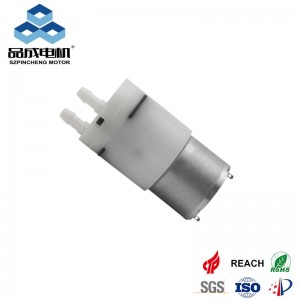
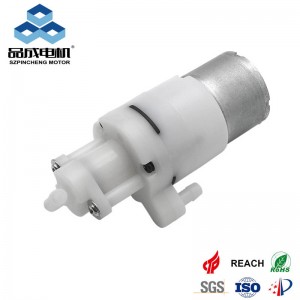
3. Micro Diaphragm Pumps: Precision & Self-Priming
Diaphragm pumps use a reciprocating action to create a vacuum. This makes them the "gold standard" for applications requiring precise dosing or gas-liquid mixtures.
Why Engineers Choose Pinmotor Diaphragm Designs:
-
Self-Priming Ability: Unlike standard DC pumps, our diaphragm models can lift liquid from a source located below the pump level.
-
Dry-Running Tolerance: The unique structure allows for air and liquid transfer without damaging the motor.
-
Contamination-Free: The fluid is completely sealed from the motor components, crucial for medical and food-grade applications.
4. Head-to-Head Comparison: Data-Driven Selection
Based on our bench tests, here is how the two technologies compare:
| Feature | Micro DC (Centrifugal) | Micro Diaphragm Pump |
| Self-Priming | No | Yes (Excellent) |
| Flow Consistency | Steady / Pulse-free | Pulsed flow |
| Noise Level | 30-45 dB (Very Quiet) | 45-60 dB (Moderate) |
| Typical Life (BLDC) | 5,000 - 10,000 Hours | 1,500 - 3,000 Hours |
| Ideal Fluid | Pure Water / Coolants | Air, Water, Corrosive Chemicals |
5. Real-World Applications (Case Studies)
At Pinmotor, we don’t just sell pumps; we solve engineering challenges. Here is where our clients use these technologies:
-
Medical Diagnostic Equipment: We supply high-precision diaphragm pumps for blood analyzers where zero cross-contamination is mandatory.
-
Smart Home Appliances: Our micro DC pumps are integrated into coffee machines for quiet, consistent water flow.
-
Environmental Monitoring: Used in portable air samplers due to their compact size and low power consumption.
6. Manufacturing Excellence & Standards
Every pump leaving our facility undergoes a rigorous 4-step quality check:
-
Motor Performance Test (RPM and Current)
-
Vacuum/Pressure Leak Test
-
Noise Decibel Verification in a semi-anechoic chamber.
-
Final Flow Rate Calibration.
Compliance Note: All Pinmotor products are manufactured under ISO 9001:2015 standards and are fully RoHS and CE certified, ensuring your products meet international market entry requirements.
7. Expert Advice: Which One is Right for You?
Choose a Micro DC Pump if: You need high flow rates, quiet operation, and your system is always "wet" (no self-priming needed).
Choose a Diaphragm Pump if: You need to move air/gas, require self-priming, or are dealing with medical-grade hygiene standards.
Need a Custom Fluid Solution?
Our engineering team is ready to provide CAD files and performance curves for your specific project.
[Contact our Engineering Team] | [Request a Sample] | [Download Full Catalog]
Micro DC & Diaphragm Pumps: Frequently Asked Questions
Q1: Can micro diaphragm pumps run dry for extended periods?
Expert Answer: Yes, unlike micro centrifugal DC pumps, micro diaphragm pumps can run dry safely.
Engineering Detail: Because our diaphragm pumps rely on the reciprocating movement of a flexible membrane rather than a high-speed impeller that requires liquid lubrication, running dry does not cause immediate damage. However, Pinmotor’s lab tests show that continuous dry running for over 24 hours may slightly increase motor temperature. We recommend a duty cycle for optimal longevity.
Q2: How do I choose between a Brushed and Brushless (BLDC) motor?
Expert Answer: It depends on your required service life and noise constraints.
- Brushed Motors: Best for intermittent use or cost-sensitive projects. Service life is typically 500–1,500 hours.
- Brushless (BLDC) Motors: Essential for 24/7 continuous operation. They offer 5,000–10,000+ hours of life, lower EMI, and quieter operation.
Q3: What is the maximum viscosity a micro DC pump can handle?
Expert Answer: Micro DC pumps are optimized for low-viscosity fluids (below 100 cps), similar to water or light oils.
Technical Tip: Higher viscosity fluids cause internal friction and motor overheating. For thick fluids, we recommend customizing diaphragm materials—contact our engineering team for a compatibility test.
Q4: Are micro diaphragm pumps self-priming?
Expert Answer: Yes, they are inherently self-priming.
Performance Data: Our PMD series can lift water from up to 3 meters (10 feet) below the pump’s location, a feature standard centrifugal DC pumps lack.
Q5: How do I reduce the noise and vibration of a micro pump?
Expert Answer: Noise often results from system resonance. Pinmotor’s engineering solutions include:
- Use flexible silicone tubing to dampen vibrations.
- Install the pump on soft rubber mounts (Isolators).
- Reducing the PWM to 80% can reduce noise by 5-10 dB.
you like also all
Read More News
Post time: Dec-11-2025